Solving the Fokker-Planck Equation
VlaPy implements the Lenard-Bernstein [LB58] (LB) approximation and the Dougherty [Dou64] (DG) approximation of the Fokker-Planck equation. The LB approximation is given by
where \(\nu_{ee}\) and \(v_0\) are the electron-electron collision frequency, and thermal velocity, respectively.
The DG approximation is given by
where \(\underline{v} = \int f v dv\) and \(v_t^2 = \int f (v - \underline{v})^2 dv\) are the mean electron velocity, and the shifted thermal electron velocity.
Differencing Scheme
This operator is differenced backwards in time, and center differenced in velocity space, which gives
where \(\bar{v} = v, v_{rms}^2 = \int f v^2 dv\) for the LB operator and \(\bar{v} = v - \underline{v}, v_{rms}^2 = \int f \bar{v}^2 dv\) for the DG operator.
and
This system can be transformed into a linear system of equations in the form of
where \(C_{ee}\) is a matrix that corresponds to the finite difference operator stencil. In 1D, \(C_{ee}\) tridiagonal matrix. that can be solved directly.
Tests
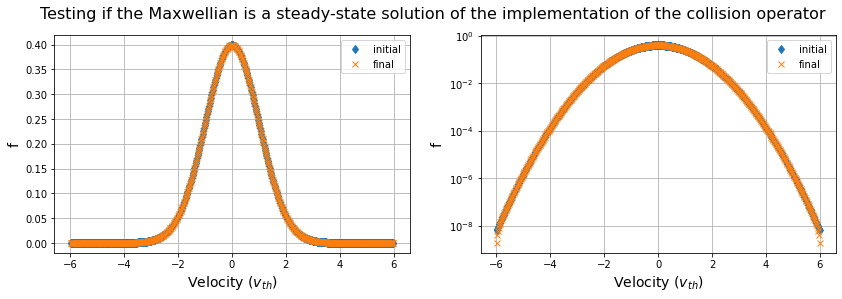
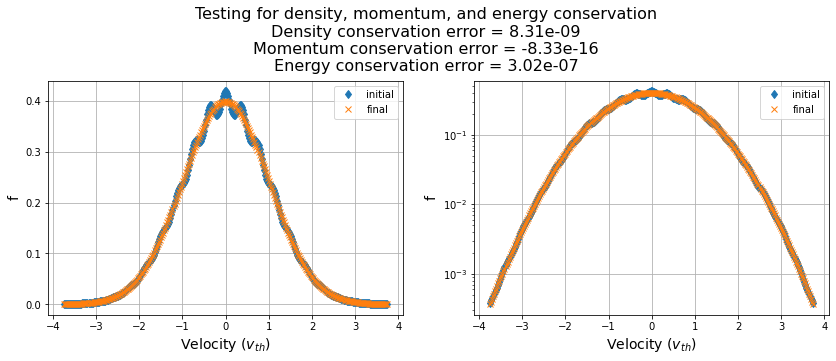
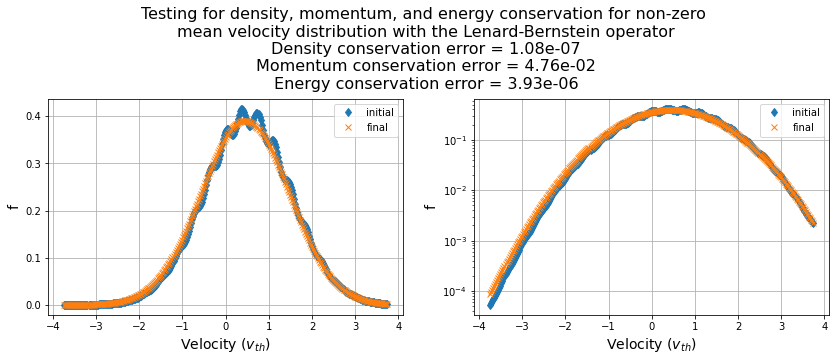
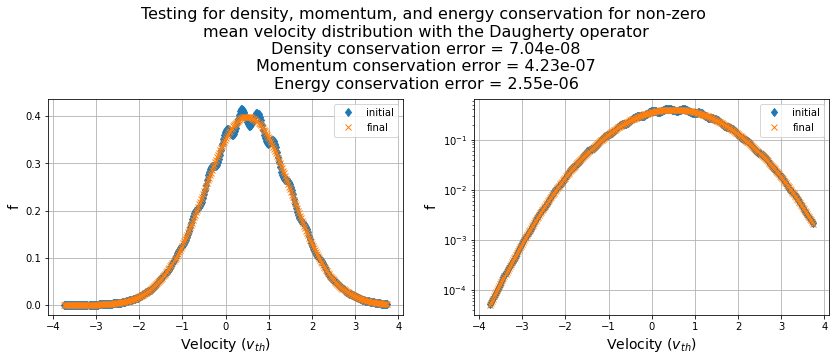
This solver is tested to 1) return df/dt = 0 if a Maxwell-Boltzmann distribution is provided as input 2) conserve density, energy, and depending on the operator, velocity. 3) relax to an operator-dependent Maxwellian of the right temperature and drift velocity.
These tests are illustrated in notebooks/test_fokker_planck.ipynb and below:
- Dou64
J. P. Dougherty. Model Fokker-Planck Equation for a Plasma and Its Solution. Physics of Fluids, 7(11):1788, 1964. URL: https://aip.scitation.org/doi/10.1063/1.2746779, doi:10.1063/1.2746779.
- LB58
A. Lenard and Ira B. Bernstein. Plasma oscillations with diffusion in velocity space. Physical Review, 112(5):1456–1459, 1958. doi:10.1103/PhysRev.112.1456.